Pajama Daze
Follow us on Facebook and Twitter
  • Home
  • Blog
    • PJ's Bookshelf
    • Entertainment Center
  • Pajama Jobs
    • Online Opportunities
  • Joyful Workers
  • Creative in Our Pajamas!
    • Poetry & Other Musings
  • Useful Links
  • Contact Us
  • About the author
  • Disclaimer

Faulty Wiring: Living with Invisible MS by Suzanne Robins

11/16/2013

0 Comments

 
Picture
I must be blunt.  Multiple Sclerosis is one helluva disease.  I don't have it, thankfully. However, reading Faulty Wiring revealed that I have risk factors, including a sister who has the disease.  Needless to say, I lost a bit of sleep over that.

I am very grateful to have read this book by Suzanne Robins.  I now understand much more about this insidious disease that assaults so many bodies and lives. Robins is a terrific writer and she describes her MS experience with candor, boldness, and finesse. Intimately, she shares the impact the disease has had on her life, her fears, and the many lessons she has learned, as well as her frustrations in finding a diagnosis and treatment.  She handles how to tell children the truth about illness with great sensitivity.  Robins also provides frank and well-researched details about the physical, mental and emotional manifestations of MS.  And her lengthy, comprehensive list of resources and references are of great value to the MS patient, as well as those wishing to learn more about the disease. 

Reading Faulty Wiring gave me a deep respect for Robins, as researching and writing a book like this is a tremendous undertaking, requiring a great amount of will, commitment, and energy.  Despite the difficulties her disease presented, she produced an excellent adjuvant resource and companion for anyone commencing on a journey with Multiple Sclerosis. I have recommended Faulty Wiring to my sister, and I recommend it wholeheartedly to you.

You can download an epub version of Faulty Wiring: Living with Invisible MS for $4.99 at https://www.smashwords.com/books/view/305742, or Kindle format ebook downloads for $4.49 at http://www.amazon.com/s/ref=nb_sb_ss_i_0_13?url=search-alias%3Dstripbooks&field-keywords=faulty%20wiring%20living%20with%20invisible%20ms&sprefix=faulty+wiring%2Cstripbooks%2C256&rh=i%3Astripbooks%2Ck%3Afaulty%20wiring%20living%20with%20invisible%20ms

0 Comments

Through the Eye of Migraine by Stefanie M. Davis

10/25/2013

1 Comment

 
Picture
Ironically, today as I write this review, I am suffering from Day 2 1/2 of a migraine.  And I can identify with just about every word about pain and frustration that Stefanie Davis wrote in her self-published Kindle ebook, Through the Eye of Migraine.

Through the Eye of Migraine is an appropriate title for a personal account of chronic migraine, not only because we see the experience through Davis' eyes, but, as I am finding at this very moment, migraine can feel like an ice pick through one's eye. 

Davis describes the frustration of migraine:  how the pain imposes restrictions on one's life;  finding a doctor with the patience, compassion and skill to diagnose and treat a migraine; becoming a "medication guinea pig" in search of a drug that will work; the financial hardship of missed work, copays and lack of insurance coverage of medications.

She goes into detail about a doctor-recommended diet to reduce migraine triggers, which the reader/migraine sufferer may find very helpful, as Davis has.  She also discusses how a migraine patient needs to do their homework to better understand their condition and treatment, and to increase the quality of relationship with the doctor.  Finally, she talks about her "heroes" and how she keeps going and coping with her migraines.

I've suffered from a spectrum of migraine symptoms, including dizziness, pain, aura, and mentally blanking out, in varying degrees of frequency and ferocity, for over 20 years.  My migraines are caused by Fibromuscular Dysplasia of the carotid and vertebral arteries, and because of other health issues, I cannot take any tradiitonal migraine medications.  Barometric pressure seems to be one of my most frequent triggers.  But migraine can have many causes and triggers.  Those with chronic migraine, no matter what the cause, will feel not so alone when they read Davis short, simple personal account of her migraine journey.

Through the Eye of Migraine can be downloaded onto Kindle from Amazon.com for $2.99, and is also available in paperback.

1 Comment

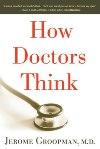
How Doctors Think by Jerome Groopman, M.D.

7/19/2013

0 Comments

 
Picture
If you have chronic illness, no doubt you have a list in your head of doctor visits that resulted in arguments, dismay, disappointment, misunderstandings, confusion, anger, frustration and/or tears.  You know what I'm talking about.  When I was going through a tragically difficult time of my life and experiencing nervousness, sleeplessness and pain, I gave my family practitioner information about Ehlers-Danlos, a connective tissue disorder. As I had been recently diagnosed with Fibromuscular Dysplasia (another connective tissue disorder), had hypermobility and pain in my joints, and learned of other FMD patients that had EDS, I thought she could give me some insight or send me to get tested to see if I did, indeed, have that disease.  My family practitioner, who never even heard of either disease, did not read my information nor pursue the matter, but instead, labeled me a hypochondriac.  She also labelled me in terms related to mental disorders.  This, after she had previously doped me up with anti-depressants and valium after recovering from a fourth heart attack, and my sleep doctor also had me on two sleeping pills because of insomnia.  I was a zombie.  A hurting zombie.  Her behavior towards me hurt even more and did not help my situation at all.  Didn't she have to take an oath - "Do no harm"?

Then last summer I injured my FMD-involved carotids by bending my neck too far back and spent a month spinning with the dizzies and falling down.  I went to my neurologist's office at a prestigious university research hospital and was sent home with the diagnosis of dehydration!  NOT!  

Thank God I now have a fantastic GP whom I trust totally and who is willing to research things he doesn't already know, and a team of specialists at Mass General who look after my FMD with great care and expertise. 

Finding the right doctor is like finding a good boyfriend.  You have to kiss a lot of frogs before you find your handsome prince!  How do you find a good doctor?  Or if you're stuck with one who has no bedside manner and won't listen to you, how do you make your relationship work?  What, and how, is that doctor thinking?

Dr. Jerome Groopman, M.D., has given us a glimpse of what goes on in the grey matter of a medical professional.  Besides revealing what makes a doctor good, he dares to uncover what makes a doctor not so good, why a doctor makes mistakes, or is difficult, arrogant or impatient.  How Doctors Think (2007, Mariner Books) is written so that, as patients, we can understand what makes our docs tick and how to get the best care possible.  It should be essential reading for medical students and physicians!

Dr. Groopman holds the Dina and Raphael Recanati Chair of Medicine at Harvard Medical School and is chief of experimental medicine at Beth Israel Deaconess Medical Center in Boston.  He is also a writer for The New Yorker and author of several books.  His exploration of how doctors think started while he was making rounds with medical students, noticing their reliance on statistics and evidence-based therapies, and their view of patient as "disease" rather than as a unique individual with a life and a purpose.  He wanted to determine why there was an absence of heart in the students' approach to medicine.

Through Groopman's many anecdotes and thoughtful examination of what makes doctors tick, the reader gains a better sense of the psychology of medical doctors and how to best approach and maintain a quality relationship with them.  The book also empowers the reader to recognize the shortcomings of a doctor, to communicate more clearly with the doctor and to help the doctor communicate more clearly with you. Ultimately, a unique partnership can be formed to support your best interest and best health.  Or, otherwise, you will be searching for a better fit for your medical care.

Your first clue as to how a doctor thinks, says Groopman, is how that doctor speaks and listens, paying attention to what is said, as well as the body language. He cites studies that conclude "...how a doctor asks questions and how he (or she) responds to... (a) patient's emotions are both key to what they term 'patient activation and engagement'". (p. 17)  

Communication is a two-way street, and how you present information, reveal yourself, and ask questions is also key in developing that partnership.  When you have many unexplained symptoms along with what has already been diagnosed, Groopman suggests an important question to ask is, "Is it possible I have more than one problem?"  Often we think it but don't verbalize it and leave the office frustrated.

I, unequivocally, recommend this book to all of you.  It's about relationship.  It's about being your own best advocate.  And most importantly, it's about getting the best medical care possible, whether for you or someone you care for. 

Thank you to Kari Ulrich from Midwest Women's Vascular Advocates for gifting me with this tremendously enriching book!  You can purchase How Doctors Think for Kindle, in paperback and hardcover, and as an audiobook on Amazon.


0 Comments

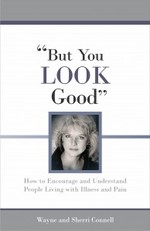
"But You LOOK Good": How to Encourage and Understand People Living with Illness and Pain by Wayne and Sherri Connell

6/10/2013

0 Comments

 
Picture
I have multiple invisible chronic illnesses.  I have lost friends and distanced acquaintances who are either tired of hearing about my health problems, if they dare ask how I'm doing, or they think I'm a fraud and a hypochondriac.  Or maybe I'm no fun anymore.  Either way, it frustrates me to no end when I feel that someone doesn't believe that I'm not well.  You know the score.  I don't necessarily mind if they say that I look good.  I'm vain enough to be grateful for one less thing in my life to rue.

Meet Sherri Connell, a beautiful and accomplished woman: former model, performer, equestrian, educated with multiple degrees.  In 1991, because of Multiple Sclerosis and Lyme Disease, her active life came crashing down.  Aware of her struggles in dealing with friends, family and others who exhibited little understanding of her situation, her husband, Wayne, created The Invisible Disabilities Association (www.invisibledisabilities.org).  Together they wrote this 56-page booklet to help encourage and create understanding for those who just don't get it that we really are sick and sometimes need to be handled with kid gloves.

As insensitive as the behavior of those "non-believers" can seem, while reading this booklet I became aware of how difficult it is for them to deal with US.  They always seem to say the wrong thing.  We frustrate them because we seem okay on the outside; how can they tell when we're not?  Why aren't we the same people we used to be?  They feel like they've lost the person they once knew.  (Yeah, we feel that way, too!)  

Wayne and Sherri take the time to explain what chronic conditions are, why we may not LOOK sick, addressing the fear that we've given up, what to say, what not to say, and how to be a comfort to someone who is chronically ill or in pain.  "But You Look Good" is a great gift to close friends, family members, and others who want to understand your situation better and do what they can to maintain a strong, supportive relationship with you.  

But what about all those other folks you encounter on a daily basis:  acquaintances who brush aside and minimize your struggles, become impatient with you, insult you, give you unwanted advice?  People who don't really care about the relationship as much as what they need out of you.  You know who I'm talking about.  Even strangers who get huffy when they see you park in a disabled space and walk without a limp into the store.  These folks will not take the time to read a 56-page booklet so that they may learn compassion and skills in dealing with people like you!  Thankfully, The Invisible Disabilities Association also offers pamphlets on their website that you can purchase in bulk to hand out to those folks.

"But You Look Good" is a compassionate book, tenderly guiding our loved ones through a journey of understanding and growth.  It is self-published by the Invisible Disabilities Association and can be purchased on their website.  Because it is self-published, the booklet is not tightly written and, perceivably, could be better as a slightly shorter publication, making it easier for people to accept it and read it.  However, that aside, it is a valuable resource for loved ones of the chronically ill, fatigued, or pained to create understanding and make our lives that much easier and more pleasant.  

Buy a bundle of these booklets for your family and close friends, and packs of the brochures to hand out to the church ladies who keep asking you to bake cakes, to your grocery store clerk who packs groceries in a bag only Arnold can lift, or to those hotheads in the parking lots!  You are on a mission to educate the world about invisible illness, and the Connells have done the hard work for you!  

0 Comments

Despite MS, to Spite MS: One couple facing the challenges of life and Multiple Sclerosis by Dan and Jennifer Digmann

5/15/2013

1 Comment

 
Picture
Despite MS, to Spite MS is a book about love.  It is a love story between two people who have MS.  It tells about a love for life, a love for fun, a love to help others, a deep love for each other.  And to read it is to fall in love with Dan and Jennifer Digmann.

Despite MS, to Spite MS: One couple facing the challenges of life and Multiple Sclerosis makes me laugh.  It makes me cry.  It makes me want to reach out and hug Dan and Jennifer, because reading it makes me feel like they are my best friends.

The book is that good.  The Digmanns are that great.

Written in essay form, actually more like journal entries, the book reveals Dan's and Jennifer's personal accounts and feelings about their battles with two different forms of MS, their relationship, their love of music and baseball, their efforts to raise awareness of Multiple Sclerosis and advocacy for others who suffer with MS.  Personal photographs are included, making your reading experience even more intimate.  The Digmanns open their lives to the reader on a level most don't.  There is pain, fear and disappointment in their experience.  Yet they bless their story with humor and candor.  It is a powerful story of living powerfully, despite MS and to spite it.

Yes, I fell in love with the Digmanns, and thank them for their beautiful, touching, enjoyable book.  All I want to do now is sit by these folks at a Red Sox game and eat hot dogs.

Despite MS, to Spite MS: One couple facing the challenges of life and Multiple Sclerosis (2011, Magee Press) is available through amazon.com and DespiteMStoSpiteMS.com.  A portion of the proceeds go to Camp Courageous and the National Multiple Sclerosis Society.  For more information about the Digmanns and their advocacy work, go to DanandJenniferDigmann.com.


1 Comment

BOOK REVIEWS: Three reviews previously published on Goin' Bananas in Pajamas Blog page

4/29/2013

0 Comments

 
Picture
Living Well with Chronic Illness: a Practical and Spiritual Guide by Richard Cheu 04/02/2013


Chapter 3 of Richard Cheu's new book, Living Well with Chronic Illness: a Practical and Spiritual Guide (2013, Dog Ear Publishing), begins with a quote by M. Scott Peck:  "The truth is that our finest moments are most likely to occur when we are feeling deeply uncomfortable, unhappy, or unfulfilled.  For it is only in such moments, propelled by our discomfort, that we are likely to step out of our ruts and start searching for different ways or truer answers." (The Road Less Traveled and Beyond: Spiritual Growth in an Age of Anxiety)

Reading that quote took me back a few weeks:  while sitting at physiotherapy, heat packs on shoulders, observing others stretch, lift, groan and grimace, it struck me that we were all people who, when  physically at our worst, were actually showing up at our best.  We were transformed when we decided to make a bad situation better; to make lemonade out of our lemon bodies.  The key word here is: decided.  For those who do not decide that they could, should or would get better, can't, shan't or won't.

​
Cheu promotes the belief that illness can be utilized as a catharsis for deep personal transformation.  A caregiver for his wife who, for the past nine years, has suffered a progressive neurological disease, Cheu has used his knowledge and background in neurophysiology, pastoral counseling and ministry, stress management and patient care, as well as his obviously compassionate heart, to help his wife and others live as positively, abundantly and healthfully as possible.

Once one makes that decision for a better life, the starting place, according to Cheu's book, is ridding oneself of emotional baggage.  This is a gigantic hurdle, for most of us carry a truckload.  Fear of change and social isolation can also be stumbling blocks on a healing journey.  Cheu gives us tools to get past those blocks and begin to see our illness as more of an opportunity so we can say "YES!" to life.

Cheu emphasizes the reduction of stress, which is no easy task.  Chronic illness in itself generates incredible stress, going from one doctor to another until they become a blur, managing medications and their scary side effects, struggling to maintain a modicum of normal activity, and wrestling with a body that says "No" when you say "Go," just to name a few.  Cheu outlines simple strategies for lessening this stress.

He also explains the stages of grief through which the chronically ill must pass:  Shock, Anger, Resistance (denial), and Acceptance.   I'm sure these stages ring true with you as they did with me.  Thankfully, Cheu walks us through each stages toward an attitude of resilience.

Though highly practical in his approach, Cheu also is deeply spiritual in practice.  However, he does not preach, nor does he espouse, any particular spiritual belief, but instead purports to guide us in seeing the bigger picture and discovering the meaning and purpose of our lives.  He then offers encouraging words and step-by-step guidance in sharing our stories with each other.

The workbook pages allow you to acknowledge your fears and isolation, and guide you through planning towards taking action.  Cheu provides inspiring and enlightening personal stories of others struggling with illness.  Learning about how others have overcome their limitations, you don't feel so alone in your suffering and you see that there is hope.

I enjoyed reading this book, but most of all, appreciated Cheu's clarity in detailing the chronic experience and guiding the reader out of the emotional deep end towards a healthier, happier, more fulfilling life.  I could easily see how far I had come in accepting my illness (which is still a work in progress), feeling good about the, sometimes, tentative baby steps and, other times, giant leaps I've taken toward reinventing my self and my life.

The only criticism I have of Living Well with Chronic Illness, and it is a petty one, is Cheu's somewhat archaic terminology when suggesting media with which to tell our stories.  Digital audio recording and online photo albums were not included.  As I said, a very small criticism.

Living Well with Chronic Illness is an easy-to-read companion for anyone suffering from a chronic illness who is ready to make a challenged life better.  I thank Richard Cheu wholeheartedly for allowing me to read and review this hopeful, enlightening and enlivening book.  It did, indeed, make a difference in my chronic life!


Picture
                    

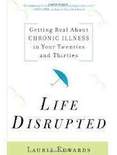
Life Disrupted: Getting Real About Chronic Illness in Your Twenties and Thirties 
​by  Laurie Edwards  
​
3/19/2013
 
Thanks to guest blogger, Rihann for this book review! Her blog is found at (http://brainlesionandme.wordpress.com)

The first book chosen by our new ‘Spoonie Book Club’ features a subject close to our hearts and one which affects us all - chronic illness.  The book, Life Disrupted: Getting Real About Chronic Illness in Your Twenties and Thirties by Laurie Edwards, does what it says on the cover, it discusses the experience of what it is like to live with chronic illness during these years, as well as those other milestones which are often experienced in your twenties and thirties, such as finishing university, beginning on the career ladder, starting relationships and later, starting a family and so on. 

Laurie Edwards is certainly qualified to write this manual for those with chronic illnesses, as she herself battles multiple chronic illnesses.  Not only does she include her own story but also features several other case studies with others battling a variety of different conditions.  In my opinion, this makes the book even more relatable, as chronic illness encompasses a wide variety of different conditions, and by including more than one story, there is something from each individual that you can relate to your own experience.

Initially, I thought that the writing style seemed rushed and forced - as if the author was merely writing down her thoughts as they came to her - and often seemed more like a diary than a manual.  However, what if we were to look at it differently?  As patients, we often have to wait a long time for answers; to get a diagnosis, wait for appointments.  So, isn’t it refreshing for a book about chronic illness to get straight to the point; to be concise and compact?  Each chapter is short, making it very easy to read little chunks when the reader feels up to it.  Fantastic for those like me who tire very easily but still like to read before going to bed.

One problem, however, is much of the book focuses on the experience of hospitalisations.  A large number of chronic illnesses, like mine, do not create such crises that require frequent hospitalisations, and therefore, I would like more content that considers living with chronic illness away from the hospital. 

The author does, however, beautifully describe how “one of the only predictable things about chronic illness is its unpredictability”,  which, in my opinion, really encapsulates the experience of living with chronic illness, as often symptoms can occur with no warning and often a person cannot tell how they are going to feel day by day, or even hour by hour.  Leading to that, one section delves into socialising with friends with chronic illness, with the author using her own and others’ experiences to explain how chronic illness can lead to many cancelled plans and apologies for missed events.  This particularly resonated with me as, like the people in the book, I often need to cancel plans at short notice because of an exacerbation of symptoms. 

A major drawback of the book is the emphasis on the US healthcare system, as, obviously, there are major differences between the healthcare system of the US and the UK, although it is interesting to contrast the two systems.  The book discusses, for example, the huge financial implications of chronic illness, something, thankfully, those living in the UK do not have to worry about.  However, in contrast to this, the author discusses the relationships she had developed with her medical team, and the frequent contact which she has with them.  I concluded that the US healthcare system allows greater control and flexibility with their medical team which, unfortunately, does not reflect the experience within the NHS.  My experience of the UK healthcare system has been long waiting times to see even a General Practitioner, and having a really hard time contacting a doctor when symptoms have become very bad. 

To conclude, although the book does have some drawbacks that I have outlined here,  it is fairly well written, and as the chapters are concise and compact, it does not take a lot of time to read.  However, some of the book's chapters did seem underdeveloped.  It does encapsulate the experiences that many face whilst battling chronic illness, and many will think “Finally! Someone understands exactly what I go through every day.” 


​

Picture
​
BEHIND THE OLD FACE: Aging in America and the Coming Elder Boom 
  • by Angil Tarach-Ritchey
  • 1/03/2013

​We are a caregiver (professional or otherwise), or we are someone who needs or will need a caregiver, or we are elderly or disabled and need to make decisions, or we are middle-aged and want to plan for our elder years, or we have an elderly person in our life.  EVERYONE falls into one of these categories, and everyone needs to read Behind the Old Face: Aging in America and the Coming Elder Boom (published by DreamSculpt Media, November 12, 2012), a groundbreaking book by Angil Tarach-Ritchey.  From challenges to the current system of care for the elderly to a vision of the future of elder care, from information on navigating the system to candid stories from the mouths of elders, Tarach-Ritchey covers the gamut of issues surrounding aging in America and what challenges lie in our future, especially if we are baby-boomers.

Tarach-Ritchey is a veritable fountain of knowledge, insight and skill in dealing with issues of the elderly.  With a background that began in nursing home care, culminating in the creation and management of her own home care agency, she brings over 30 years of experience to the reader in a vehicle of profound sensitivity and compassion.  She is the author of Quick Guide to Understanding Medicare, Medic-aid and other payer sources, available on Amazon Kindle, and  "The Aging Question; A Vision for the Coming Elder Boom", a M2 Ebook, as well as being featured on websites, in publications, and as a guest speaker on matters of the elderly.  She is founder of The Elder Boom™ Foundation, a "501C3 non-profit dedicated to educating families, professional caregivers and healthcare professionals to a new vision of senior living and care." 

I am both a caregiver for my father and a baby-boomer with numerous health issues who needs to think about my own care in the future.  I found this book easy to read and jam-packed with useful information and resources.  It was also a good smack in the head when it comes to our own perceptions of the elderly.  There is a story behind every old face, and sometimes we are in too much of a hurry, too distracted, too impatient to hear that story.  What a blessing to have Tarach-Ritchey open our eyes and give us her hand and guide us through the murky waters of aging!  How blessed are the aged to have an advocate like her to stand beside them!

​Note:  Angil Tarach-Ritchey passed away in 2015.  Her passion, knowledge, caring and humor is deeply missed by many, including me.

0 Comments
Forward>>

    PJ's Bookshelf

    Reviews are the opinion of the author of this website unless otherwise indicated.

    Archives

    April 2020
    July 2019
    April 2019
    August 2017
    June 2017
    February 2017
    February 2016
    January 2016
    August 2015
    July 2015
    March 2015
    February 2015
    November 2014
    August 2014
    July 2014
    March 2014
    February 2014
    January 2014
    December 2013
    November 2013
    October 2013
    July 2013
    June 2013
    May 2013
    April 2013

    Categories

    All
    Caregiving
    Chronic Illness/Fatigue
    General Health

    RSS Feed

Powered by Create your own unique website with customizable templates.
Photo from Stéfan